
Vaccinations and premature babies: What parents need to know

By Heather Cresswell, Neonatal Nurse Practitioner

If you are the parent of a premature baby and wonder if and when your baby should get vaccinations, you are not alone. April 26-May 2 is National Immunization Awareness Week, so what better time than now to dive into this important topic! Read on to learn all about vaccinations and premature babies.
Vaccination and immunization: are they the same?
People often use the terms vaccination and immunization interchangeably. They are closely related, but are not exactly the same.
Immunization is the process of becoming protected against a disease. Immunization can happen through:
A vaccination (the body makes antibodies in response to a vaccine)
Exposure to a disease (the body makes antibodies in response to a virus or bacteria)
Passive immunization (antibodies are received through the placenta, breastmilk or in the form of a prevention injection, nasal spray or oral medicine)
So, vaccinations (the act of giving a vaccine) are one type of immunization, but not the only way we can become immune to a disease.
For this blog post, we will mostly discuss vaccinations.
How do vaccines work?
Vaccines work by training our immune systems to recognize and be ready to fight diseases caused by certain bacteria or viruses.
Vaccines might be an injection, a nasal spray or an oral form (a pill or liquid to swallow).
When a vaccine enters the body, it introduces a harmless form of a virus or bacteria that is weakened, dead, or altered and does not cause disease–this is called an antigen. The antigen tricks our body into thinking it is a real bacteria or virus. Our immune system makes antibodies (cells that fight disease) and memory cells (T cells and B cells) that remember how to fight the bacteria or virus in the future. These antibodies and memory cells help our body develop immunity to a disease.
Should my premature baby get vaccinated?
Health Canada recommends the first routine vaccinations at 2 months of age for all babies, including preemies. For premature babies, this means 2 months from the day they were born, not from their due date.
Premature babies are more vulnerable than term babies when it comes to getting sick with a preventable infection:
A mother’s antibodies start crossing the placenta to the baby at about 28 weeks gestation. Babies born early miss out on this immunity boost.
Premature babies have an immature immune system, making it harder for them to fight infections.
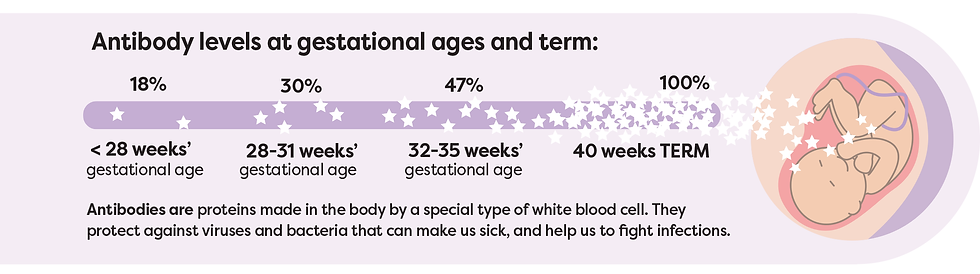
Because premature babies are vulnerable to preventable infections, experts agree they should receive vaccines on the same schedule as term babies (based on their birthday or chronological age).
If your baby is in the NICU at 2 months old, the NICU team can give them their 2-month vaccinations. Your baby’s team will talk to you about vaccinations and give them only with your consent. If your baby is having medical challenges when the time for vaccination comes around, the NICU team may talk to you about changing your baby’s vaccination schedule to meet their unique needs.
Premature babies and vaccine side effects
All vaccinations recommended in Canada have undergone years of research and extensive testing to ensure they are safe and effective in reducing the risk of preventable diseases.
The most common side effects from vaccines are redness, swelling and discomfort at the injection site. Some people may feel unwell, tired or have a mild fever and muscle aches after a vaccination. These side effects generally go away on their own after 24-28 hours, or can be treated with over-the-counter medications.
Babies who are still premature when they get their 2-month vaccinations may have an increased risk of apnea (a brief pause in breathing) or bradycardia (a brief low heart rate). If your baby is still in the NICU, they will be monitored carefully for any side effects for a couple of days after vaccinations. Your NICU team can also give acetaminophen if your baby develops a fever, but this side effect is less common in young, premature babies.
Once your baby is mature enough for discharge home, they are also mature enough to handle vaccinations without extra monitoring. Your baby’s healthcare provider will talk to you about what to watch for after vaccinations and how to manage any temporary side effects at home.
Frequently asked questions
When a baby is still premature and in the NICU, it is common for parents to worry about their baby getting vaccinations. Be sure to talk to your baby’s healthcare provider about your questions!
What’s in a vaccine? Vaccines contain an antigen (a harmless form of an altered or partial virus), preservatives (to keep the vaccine stable and effective), a medium (often a liquid to make the vaccine into an injectable, oral or spray form), and sometimes adjuvants (a fancy word for extra ingredients that help a vaccine’s effectiveness).
What about the RSV vaccine? Premature babies may be eligible for a preventive antibody that gives passive immunity against the respiratory syncytial virus (RSV). It’s not a vaccine. Talk to your baby’s healthcare provider to see if your baby should have RSV prophylaxis (preventative medicine containing antibodies).
Can I delay my baby’s vaccines? If your baby is sick when it’s time for the 2-month vaccines, your baby’s healthcare provider may talk to you about delaying vaccination. In most cases, experts agree that premature babies should have their vaccines on time. Talk to your baby’s healthcare team if you have concerns about vaccinations.
How can I help my baby when they get a vaccine? If your baby is getting a needle, talk to the nurse about breastfeeding (or cuddling with a soother) during or right after the injection. If your baby is still in the NICU and is not ready for breastfeeding, you can talk to your baby’s nurse about holding skin-to-skin (kangaroo care) during or right after the needle or giving a hand hug inside the isolette (your nurse can talk to you about other comfort measures as well!).
Bottom Line
Premature babies are especially vulnerable to preventable diseases and should receive vaccinations on schedule according to their birth date. It’s totally normal for parents to have questions and concerns, especially when their baby is still in the NICU. Rest assured that your baby’s team will talk to you about the best timing of vaccination for your baby. It’s never too early to talk to your baby’s team and get your questions answered!
Check out and share the Canadian Premature Babies Foundation infographic all about childhood vaccines! It’s also available in French.
Resources
Canadian Premature Babies Foundation. Childhood Vaccines. https://www.cpbf-fbpc.org/childhood-vaccines
Caring for Kids (Canadian Pediatric Society). Immunization. https://caringforkids.cps.ca/handouts/immunization
Government of Canada (Health Canada). Immunization of infants born prematurely: Canadian Immunization Guide. https://www.canada.ca/en/public-health/services/publications/healthy-living/canadian-immunization-guide-part-3-vaccination-specific-populations/page-5-immunization-infants-born-prematurely.html
Government of Canada (Health Canada). How Vaccines Work. https://www.canada.ca/en/health-canada/services/video/how-vaccines-work.html
Immunize Canada. Vaccine Basics. https://www.immunize.ca/questions-and-answers

Heather Cresswell is a Neonatal Nurse Practitioner and health writer. As a nursing student in 1995, Heather discovered the NICU during a clinical placement and never looked back. She has spent her entire nursing career (more than 25 years and counting) caring for NICU patients (premature babies are her favourite!). When not caring for her tiny patients, Heather is also a health writer and is happy to contribute to the Canadian Premature Babies Foundation.
Heather lives with her family in Burlington, Ontario, and is a proud mom and dog owner.


Comments